







English Clubs in the UEFA Super Cup: Winners, Records and Results
English clubs have a long and successful UEFA Super Cup history, from Liverpool’s first triumph in 1977 to Manchester City’s victory in 2023 and Tottenham’s dramatic defeat by PSG in 2025. Readers following the latest European football markets can also compare current UK betting bonuses around major UEFA fixtures, but the record books themselves tell an impressive story: England has produced more different Super Cup-winning clubs than any other nation.
English clubs’ UEFA Super Cup record
| Club | Completed appearances* | Titles | Defeats | Winning years |
|---|---|---|---|---|
| Liverpool | 6 | 4 | 2 | 1977, 2001, 2005, 2019 |
| Chelsea | 5 | 2 | 3 | 1998, 2021 |
| Manchester United | 4 | 1 | 3 | 1991 |
| Nottingham Forest | 2 | 1 | 1 | 1979 |
| Aston Villa | 1 | 1 | 0 | 1982 |
| Manchester City | 1 | 1 | 0 | 2023 |
| Arsenal | 1 | 0 | 1 | — |
| Tottenham Hotspur | 1 | 0 | 1 | — |
| Total | 21 | 10 | 11 | — |
*Before Aston Villa’s 2026 Super Cup against PSG.
Which English club has won the most UEFA Super Cups?
Liverpool lead the English record with four Super Cup victories.
The Reds won in:
- 1977 – beat Hamburg 7-1 on aggregate
- 2001 – beat Bayern Munich 3-2
- 2005 – beat CSKA Moscow 3-1 after extra time
- 2019 – beat Chelsea on penalties after a 2-2 draw
They also lost finals against Anderlecht in 1978 and Juventus in 1984. No other English club has more than two titles.
English UEFA Super Cup winners
England’s 10 trophies are shared between six clubs:
| Club | Super Cup titles |
|---|---|
| Liverpool | 4 |
| Chelsea | 2 |
| Aston Villa | 1 |
| Manchester City | 1 |
| Manchester United | 1 |
| Nottingham Forest | 1 |
That gives England six different winners, one more than Spain’s five. Spain nevertheless remains well ahead in total titles, with 17 to England’s 10 before the 2026 final.
Who was the last English club to win the UEFA Super Cup?
Manchester City are the most recent English winners.
Pep Guardiola’s side drew 1-1 with Sevilla in the 2023 Super Cup before winning the penalty shoot-out 5-4. England had an opportunity to add another trophy in 2025, when Tottenham led Paris Saint-Germain 2-0 before PSG recovered to draw 2-2 and win the shoot-out 4-3. Villa now have the next opportunity.
Aston Villa’s 1982 UEFA Super Cup win over Barcelona
Aston Villa’s only previous Super Cup appearance produced a trophy – but the story is slightly more complicated than the label “1982 Super Cup” suggests. The final was played over two legs in January 1983.
Barcelona 1-0 Aston Villa
The first leg took place at Camp Nou on 19 January 1983. Marcos Alonso scored the only goal after 52 minutes, sending Barcelona to Birmingham with a 1-0 advantage.
Aston Villa 3-0 Barcelona after extra time
Seven days later, Villa overturned the deficit at Villa Park.
Gary Shaw scored in the 80th minute to level the tie on aggregate before two extra-time goals completed the comeback:
- 80′ – Gary Shaw
- 100′ – Gordon Cowans, penalty
- 104′ – Ken McNaught
Villa won the second leg 3-0 after extra time and the tie 3-1 on aggregate.
“The Barcelona Super Cup second-leg at Villa Park was pretty special.” — Nigel Spink
It remains one of the defining nights of Villa’s golden European period.
Why the 1982 final was played in 1983
This is the detail that can cause confusion when looking through historical results.
The competition was officially the 1982 UEFA Super Cup, but scheduling meant the two matches were not played until January 1983.
That was not unusual during the Super Cup’s early years. The competition was generally a two-legged tie before permanently moving to its current one-match format in 1998.
Aston Villa’s place among English Super Cup winners
Villa currently sit in the group of English clubs with one title:
- Aston Villa – 1
- Manchester City – 1
- Manchester United – 1
- Nottingham Forest – 1
Chelsea have two and Liverpool four.
Every English UEFA Super Cup defeat
English clubs have also finished runners-up 11 times in the 21 completed appearances before Villa’s 2026 final.
| Year | English club | Opponent |
|---|---|---|
| 1978 | Liverpool | Anderlecht |
| 1980 | Nottingham Forest | Valencia |
| 1984 | Liverpool | Juventus |
| 1994 | Arsenal | AC Milan |
| 1999 | Manchester United | Lazio |
| 2008 | Manchester United | Zenit |
| 2012 | Chelsea | Atlético Madrid |
| 2013 | Chelsea | Bayern Munich |
| 2017 | Manchester United | Real Madrid |
| 2019 | Chelsea | Liverpool |
| 2025 | Tottenham | PSG |
UEFA’s complete competition history confirms each of those results, including the all-English Liverpool-Chelsea final in 2019.
England vs Spain in the Super Cup
The national comparison provides another useful layer. Before the 2026 final:
| Nation | Titles |
|---|---|
| Spain | 17 |
| England | 10 |
| Italy | 9 |
| Belgium | 3 |
| Germany | 2 |
| Netherlands | 2 |
England therefore trails Spain for total trophies but leads every nation for number of different winning clubs, with six. Villa themselves contributed to that record by beating Barcelona in 1982.
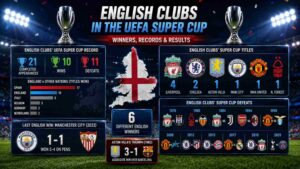
English clubs and the UEFA Super Cup: key numbers
A betting angle for major UEFA finals
Historical records are useful context, but they should not be treated as a betting system in isolation.
For a one-off Super Cup, current fitness, starting line-ups and how seriously each manager approaches the fixture can be much more relevant than a club’s record from previous decades.
For markets such as match winner, both teams to score or player shots, checking the confirmed XI before committing to a selection is therefore particularly valuable.