







The Scottish Premier League ‘split’: In defence of the SPFL’s odd structure
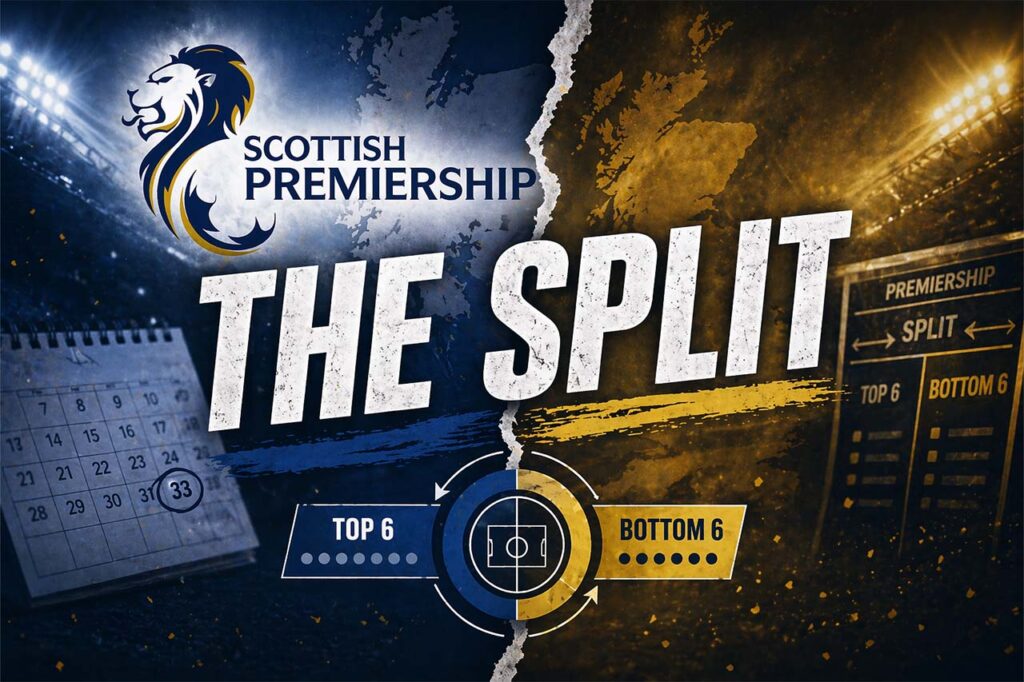
The 12-team Scottish Premiership splits into two divisions after 33 games in order to create a 38-game season.
It is controversial, slightly odd and often criticised or mocked, but the Scottish Premiership’s “split” actually has a lot going for it and was made for seasons like this one. With a genuine three-way title race going into the final five games of the campaign, this peculiar league structure ensures maximum competitiveness and interest on the final straight.
It has been a remarkable season in the Scottish top flight and with five games to play, Hearts sit top of the Premiership, one point ahead of Rangers and three ahead of Celtic. This makes it the most intense and closely-fought title race in living memory for many fans; indeed, the last time there were three teams vying for the title at this point in the year was 1997/98.
It is rare for any league to have three contenders still in the hunt for the title at this stage in the season, let alone the Scottish Premiership which has historically been dominated by the Glasgow giants of Celtic and Rangers. And even when Aberdeen finished in between those two in 2016/17 and 2017/18, they were already well behind eventual champions Celtic after 33 games played.
How the split makes things more exciting
The league split makes the title race even more intense as the contenders will now all play each other in the final weeks of the season and all of their final five games will be against top-six opposition. Not many other leagues in the world boast a system that guarantees the best teams all playing each other in the final month of the season.
With the title on the line and every point precious, there are no “easier” games left for the top three as the teams in the bottom six will all be playing each other and mostly hoping to avoid the relegation playoffs. Livingston in last place aren’t mathematically relegated yet, but would require a minor miracle to avoid the drop.
Thanks to the split, every weekend between now and the end of the season (on May 16) involves either: one of the top three playing each other or a city derby. The only round of fixtures not involving one of those scenarios is the penultimate one, a midweek card on Wednesday, May 13.
No easy games after the split

That said, however, the other three teams in the top six should not be underestimated by any account. Scottish Cup semi-finalists Falkirk in 6th have been earning many plaudits this season for their style of play under John McGlynn and they have already taken points off Rangers twice.
Hibernian, in 5th, will be hoping to pip Motherwell to 4th and a European place, and you can be sure they’ll be extra motivated in the Edinburgh derby by the chance to dent their rivals’ title chances. The Hibees have already taken points off all of the top three this season.
Motherwell, meanwhile, may be the stiffest test for the title hopefuls, outside of their games against each other, as they have only lost four of their 12 games against the top three this season and have conceded fewer goals than both Celtic and Rangers. Indeed, the Steelmen have been one of the sensations of the season and have five players in the PFA Scotland Team of the Year, as voted for by the players.
What is the Scottish Premiership split?
Since 2001/02, the Scottish Premiership has had a peculiar element in its structure known as the “split”. After each team has played 33 games – three versus every other team – the league splits into two divisions of six who then all play each other once more.
The league’s governing body – the Scottish Professional Football League – must take into account a litany of factors to strive to provide the fairest set of fixtures possible. Ideally, every team must play 19 home games and 19 away games, but this is almost never possible and this season Falkirk will play 20 home games, while Livingston will play 20 away games.
The spread of home and away games in the initial 33 rounds of fixtures is decided by predicting who will finish in which half of the table. As newly-promoted Falkirk were not expected to make the top six this season, that has caused some discrepancies.
Surprise package Falkirk gave the SPFL a headache
Falkirk’s unexpected presence in the top six means that even though they will play an extra home game overall, they will go to Celtic Park for a third time this season instead of having a second home game against the reigning champions.
That is because Celtic only played 16 home games (not 17) pre-split and this fixture essentially replaces the second home game they would have been expected to play against Aberdeen post-split, had the Dons not ended up in the bottom six.
Falkirk will also get extra home games (so a total of three home and one away over the season) against Rangers and Hibs. The reason all the fixture anomalies involve Falkirk is partly due to their unexpectedly good performance but also so as to affect the title race as little as possible, by avoiding discrepancies in the fixtures between teams higher up the table.
It’s not perfect but let’s enjoy what the split offers
While more often than not, the split system does throw up these minor discrepancies, the upside outweighs such concerns and this season is the perfect example. Three teams chasing the title and all having to play each other and their arch rivals, along with the other top teams in the league, in the final weeks of the season.
The split is essentially a solution – arguably the only one – to wanting a 38-game calendar with a 12-team league, but what it offers fans, even if by a happy accident, is an intense end to the season with increased competitiveness when it matters the most. It might not be perfect, but it is something special and relatively unique that fans and stakeholders in Scottish football should be cherishing and advocating for, rather than paranoically complaining that their particular club’s post-split run of games could have been more advantageous.