








Why Does the World Grand Prix Darts Use Double-In, Double-Out?
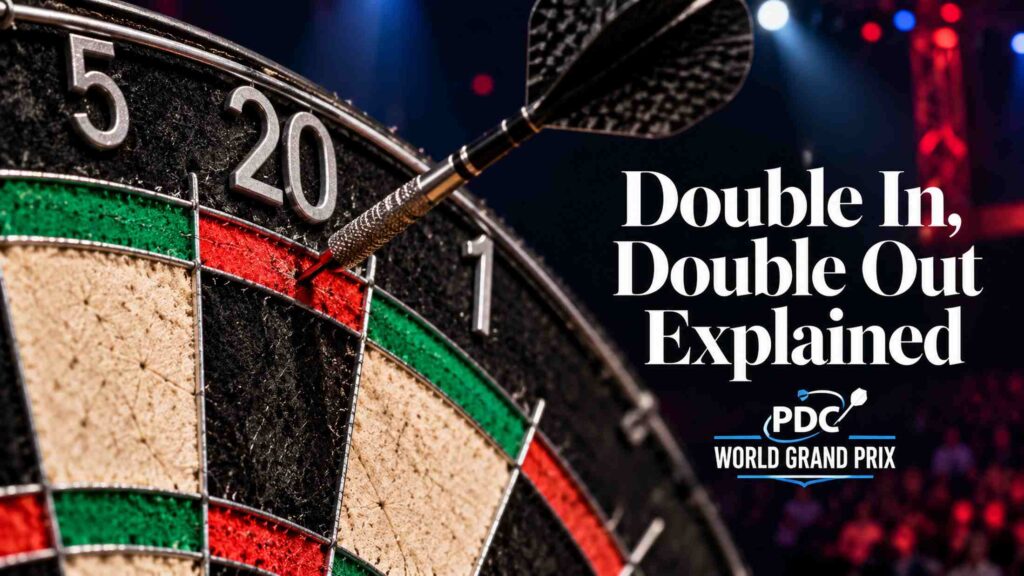
The World Grand Prix double in rule gives darts its most uncomfortable opening scene: a superstar, a waiting crowd and a scoreboard refusing to move. Double in double out darts makes every leg a test of nerve at both ends, which explains why familiar favourites can suddenly look strangely ordinary in Leicester.
What does double-in, double-out actually mean?
Each player begins a leg on 501. Before deducting anything, they must hit a double: the narrow outer scoring ring or the inner bullseye, worth 50. The opening double itself counts towards their score.
After that successful dart, normal scoring applies. Players can aim at singles, trebles or doubles until they reach a finish. To win, they must reduce their remaining total to exactly zero with a double or the bullseye.
The outer bull, worth 25, cannot open or finish a leg. Nor does hitting treble 20 allow a player to start, however impressive the grouping.
A three-dart example
Imagine a player aiming at double 20. Here is how one visit could unfold.
| Dart | Result | Score remaining |
|---|---|---|
| First | Single 20, ignored | 501 |
| Second | Double 20, scores 40 | 461 |
| Third | Treble 20, scores 60 | 401 |
That visit scores 100. The single before the opening double never gets added back. If all three darts miss a starting double, the player remains on 501 and tries again next visit.
Why does the World Grand Prix use this format?

Double-start has been part of the tournament since its first edition in 1998. It is the event’s defining sporting identity, placing precision under pressure alongside heavy scoring.
The difference is practical. In standard straight-start darts, a missed treble can still score a single. Here, missing the opening double can hand an opponent an entire scoring visit without an answer.
Once a player gets away, they do not need another starting double during that leg. The requirement resets with the next leg, not every throw.
A bust at the finish ends the visit and restores the score from its beginning. Scoring too many, leaving one, or reaching zero without the required double causes a bust.
Sets and legs: where the jeopardy grows
Three legs win a set. However comfortably a player wins those legs, the next set starts level.
For 2026, the match lengths are:
- First round: best of three sets.
- Second round and quarter-finals: best of five.
- Semi-finals: best of nine.
- Final: best of eleven.
That short opener gives a slow starter little recovery time. Across longer matches, there are more opportunities to recover, although every new leg repeats the same opening examination.
For viewers, the clearest clue is the remaining score. An opponent already below 300 while someone still shows 501 has gained a meaningful advantage, even before either player approaches a finish.
World Grand Prix odds: doubles before reputation
The scoreboard lesson carries into betting. These first-round prices show three different favourites, but none can score before getting in.
Market snapshot checked 28 September; individual operator prices may differ. Match winner, correct set score and total sets answer different questions, so check the settlement terms.
Starting-double accuracy and checkout percentage describe separate skills. A strong finishing record does not automatically establish reliable opening doubles, while one poor visit proves little about either.