


Premier League gambling shirt sponsor ban explained: what changes in 2026/27?
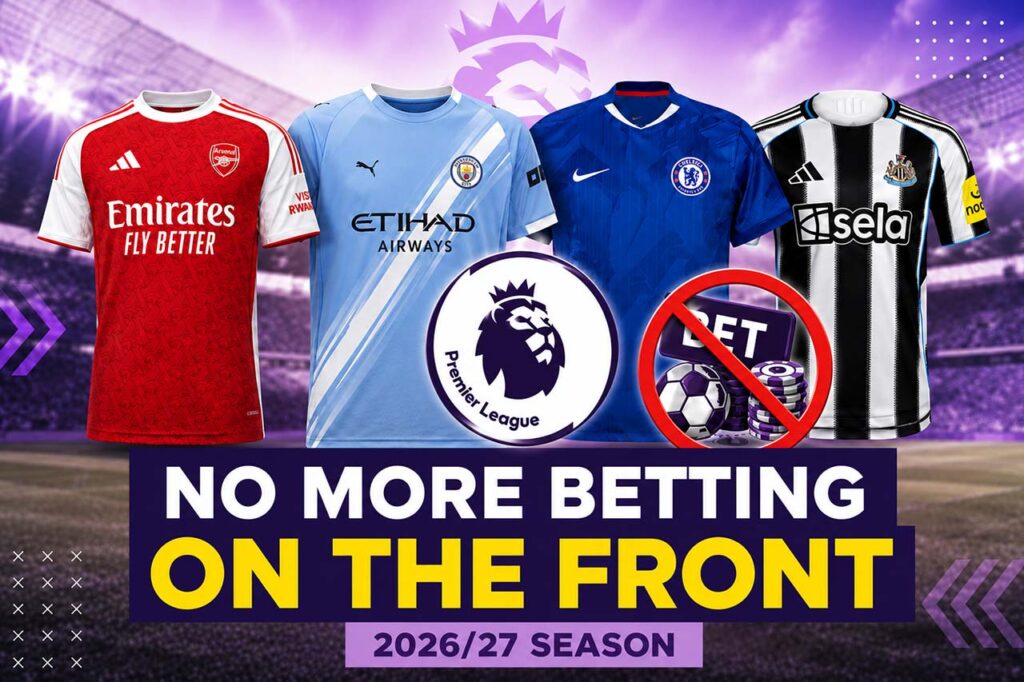
However, this is not a complete ban on betting sponsorship in the Premier League. Gambling brands can still appear on shirt sleeves, training wear, advertising boards and in other club partnerships, provided those arrangements comply with the relevant advertising and licensing rules.
What is the Premier League gambling sponsor ban?
Premier League clubs collectively agreed to remove gambling sponsorship from the front of their matchday shirts in April 2023. The agreement was delayed until the end of the 2025/26 season to give clubs time to complete existing contracts and find replacement partners.
That point matters. The change was not imposed through an Act of Parliament and it is not a general prohibition on gambling advertising. It is a collective commercial agreement between Premier League clubs covering one particularly prominent area of their kits.
The final season in which a gambling company could be the main front-of-shirt sponsor was 2025/26. From 2026/27 onwards, the central position on a Premier League match shirt must be occupied by a non-gambling brand or left empty.
What changes on Premier League shirts in 2026/27?
The most obvious change is that supporters will no longer see betting or casino brands placed across the chest of Premier League players.
That space can still be sold to companies from other industries. Insurance, technology, financial services, airlines and recruitment businesses are among the sectors moving into positions previously occupied by gambling operators.
The restriction applies specifically to front-of-shirt gambling sponsorship. Other forms of betting-related commercial activity remain possible.
Clubs must still comply with the rules set by the Gambling Commission, the Advertising Standards Authority and the Committee of Advertising Practice. Being permitted under the Premier League agreement does not automatically make every advertising campaign acceptable.
Is gambling sponsorship completely banned in the Premier League?
No. Describing the change as a complete Premier League gambling ban would be inaccurate.
A betting company cannot occupy the main front-of-shirt position, but it can potentially remain connected to a club through:
- A sleeve sponsorship
- Training wear
- Pitchside LED boards
- Stadium advertising
- Matchday hospitality
- Digital partnerships
- Safer gambling campaigns
- Official betting partner status
- International commercial agreements
Supporters will therefore continue to encounter betting brands during Premier League matches. The logos will simply be less prominent than when they appeared across the front of every match shirt.
Advertising created as part of those partnerships must also follow the UK advertising code. Football has strong appeal to children, so gambling companies face strict limitations over the players, club imagery and promotional material they can use.
The latest ASA guidance on gambling sponsorship makes clear that having a contractual right to use a club’s logo does not exempt an operator from rules designed to protect under-18s.
Which Premier League clubs are affected?
The biggest impact falls on clubs that entered the 2025/26 season with a gambling company as their principal shirt sponsor. These teams have had to find a replacement brand, leave the front of the shirt empty or move their existing betting partner to another permitted position.
Some clubs planned their transition well in advance.
Other clubs have explored moving their betting partners from the chest to the sleeve. This allows the commercial relationship to continue while complying with the new Premier League agreement.
The result is not necessarily a sponsor-free shirt. In most cases, one commercial logo is simply being replaced by another.
How much could the ban cost Premier League clubs?
The financial effect will not be shared equally across the league.
Mid-table and newly promoted clubs have traditionally found betting companies more willing to pay a premium for shirt sponsorship. Premier League coverage provides gambling brands with global exposure, including in overseas markets where the clubs themselves may have relatively small commercial operations.
Reports in April 2026 suggested that the combined reduction in front-of-shirt income could reach £80 million. Offers made to some clubs outside the traditional top six were reportedly around 50% lower than the previous deals available from gambling companies.
There is no single confirmed league-wide figure because most sponsorship agreements remain private. Nevertheless, the early replacements indicate that several clubs have accepted less lucrative deals in exchange for greater certainty and longer-term partnerships.
Why did Premier League clubs introduce the ban?
The stated objective is to reduce the visibility of gambling advertising, particularly among children and people vulnerable to gambling-related harm.
Gambling Commission research found that 69% of young people surveyed in 2024 remembered seeing or hearing gambling advertising through at least one source. Around 40% recalled gambling promotion at sporting events, including adverts on players’ shirts or around the pitch.
Removing betting brands from the chest of Premier League players reduces the most prominent form of that exposure. Critics of the agreement argue that the impact will be limited while sleeve sponsorship and stadium advertising remain permitted.
Both arguments contain some truth. The ban removes an extremely valuable advertising position, but betting branding will not disappear from Premier League football.
What happens to children’s replica shirts?
Gambling logos were already subject to tighter restrictions on products intended for children.
Operators must ensure that their branding does not appear on commercial merchandise designed for children, including junior replica shirts. Football Association rules also prevent gambling logos from appearing on the kit or clothing of teams whose players are all under 18.
This is not a new measure introduced for 2026/27. The front-of-shirt agreement makes the distinction less noticeable because adult match shirts will no longer carry a gambling company as their principal sponsor either.
Does the Premier League ban apply to the Championship?
No. The voluntary agreement only covers Premier League clubs.
Championship, League One and League Two teams remain free to enter gambling sponsorship agreements, subject to existing laws and advertising rules. The EFL also retains Sky Bet as its title partner until the end of the 2028/29 season.
 Visit
VisitA club relegated from the Premier League would therefore enter a competition with a different sponsorship policy. Equally, a promoted club must comply with the Premier League front-of-shirt agreement once it joins the top flight.
Could gambling sponsorship face further restrictions?
Yes, but this is a separate issue from the Premier League shirt agreement.
Under current legislation, an overseas gambling company may enter a sponsorship agreement if its services are inaccessible to consumers in Great Britain. These websites typically use geographical blocking, although the Government argues that such controls can be circumvented through virtual private networks.
The proposed legislation would go considerably further than the Premier League measure. It could prevent unlicensed operators from appearing on:
- Shirt sleeves and other kit
- Training wear
- Pitchside boards
- Stadium infrastructure
- Matchday programmes
- Competition and venue names
- Other physical sponsorship assets
The Government’s preferred option is to introduce the restriction in August 2027, before the beginning of the 2027/28 football season. However, this is currently an open government consultation, rather than confirmed legislation.
Licensed gambling companies would not automatically be prohibited under this proposal. They could continue using permitted sponsorship positions, provided they complied with UK law, Gambling Commission requirements and advertising standards.
What does the shirt sponsor ban mean for supporters?
The rule does not change whether betting on the Premier League is legal. Adults in Great Britain can continue to bet with operators licensed by the Gambling Commission.
It also does not mean that a club’s betting partner has been personally recommended by its players, manager or supporters. Sponsorship is a commercial transaction and should not be treated as evidence that an operator offers fair terms, quick withdrawals or suitable customer protection.
The BetBrothers view
The front-of-shirt ban is a meaningful change, but its practical scope should not be exaggerated. Gambling brands are losing the most prominent position in English club football, not their ability to work with Premier League teams altogether.
For clubs, the challenge is replacing valuable commercial income. For licensed operators, attention is likely to move towards sleeves, training kits, digital activations and partnerships built around content rather than a single logo.
For supporters, the more important distinction is not whether a gambling company appears on a shirt. It is whether the operator is licensed, transparent and suitable for the individual using it.
The 2026/27 shirts will look different, but the relationship between football and betting is not ending. It is becoming less visible on the pitch and more tightly scrutinised away from it.