







How Much Do Footballers Get Paid to Play in the World Cup?
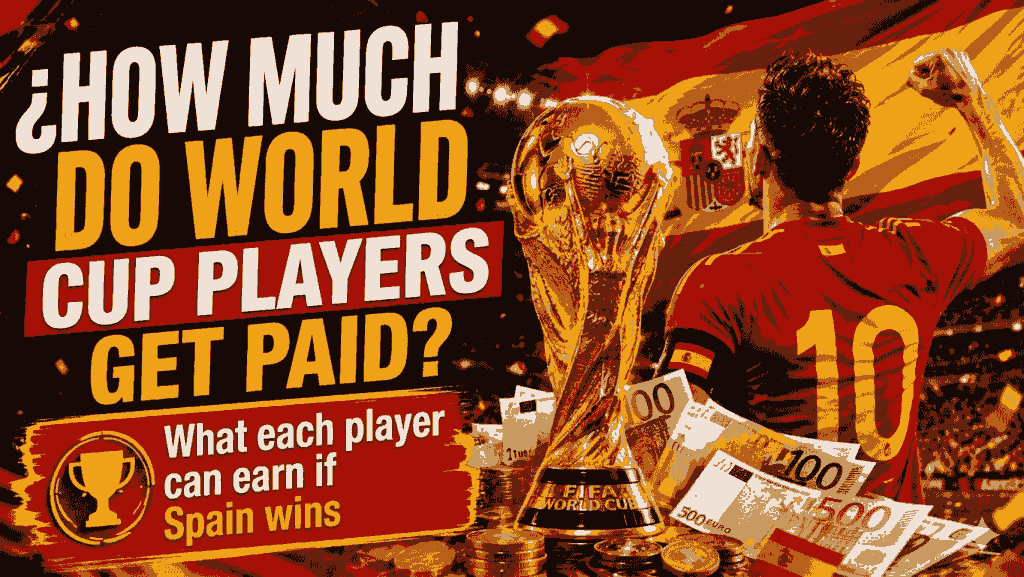
Playing in a World Cup is the dream of every footballer. But beyond the prestige, the national team shirt, and the chance to lift the World Cup trophy, there’s one question that always sparks curiosity: how much do players actually get paid to play in the World Cup?
The answer isn’t as straightforward as you might think. Footballers do not receive a fixed salary for being called up by their national team, as they do with their clubs. Instead, they earn bonuses, match payments, and rewards linked to performance. And if a team goes deep into the tournament, the total amount can increase dramatically.
Because most football associations do not publicly disclose the exact agreements they have with their players, it can be difficult to know precisely how much each international footballer earns. However, there are some well-known examples. In Spain, based on publicly reported figures from the 2022 FIFA World Cup in Qatar and estimates for the 2026 tournament, each player could earn around €75,600 before tax simply for taking part in the group stage and more than €600,000 before tax if Spain were to win the competition.
Do Players Get Paid Just for Going to the World Cup?
Not exactly. A footballer does not receive a monthly wage for representing their national team. Their primary salary continues to be paid by their club.
What exists at a World Cup are agreements between each football association and its players. These bonuses are usually linked to matches played, stages reached, and objectives achieved.
In addition, FIFA does not pay players directly. FIFA pays national football associations, and each association decides how part of that money is distributed among players, coaches, and support staff.
How Much Does a Footballer Earn Per Match at the World Cup?
The amounts vary significantly from country to country. Every football association negotiates its own agreements, and these details are not always made public.
One of the best-known examples comes from Spain. During the 2022 FIFA World Cup in Qatar, the Royal Spanish Football Federation (RFEF) reportedly agreed to pay players €25,200 per match. Since Spain were guaranteed three group-stage matches, every player was assured a minimum of €75,600 before tax.
If a similar structure remains in place for the 2026 World Cup, the estimated earnings would look like this:
| Stage Reached | Matches Played | Estimated Earnings Per Player |
|---|---|---|
| Group Stage | 3 | €75,600 |
| Round of 32 | 4 | €100,800 |
| Round of 16 | 5 | €126,000 |
| Quarter-finals | 6 | €151,200 |
| Final or Third-Place Match | 8 | €201,600 |
The real money, however, comes from performance bonuses.
How Much Would Each Player Earn If Spain Won the World Cup?
If Spain were to win the 2026 FIFA World Cup, each player could comfortably earn more than €600,000 before tax.
The calculation starts with the €201,600 a player would receive for participating throughout the entire tournament. On top of that, there would be a substantial bonus for winning the World Cup itself.
Assuming a bonus of around €400,000, each Spanish international could earn approximately €601,600 before tax. If the Spanish Football Federation increases bonuses in line with FIFA’s expanded prize fund, the final amount could be even higher.
How Much Prize Money Does FIFA Distribute at the 2026 World Cup?
The 2026 FIFA World Cup will be the largest in history, featuring 48 national teams and an expanded format. That also means more prize money.
FIFA has approved a record contribution of $727 million for the 2026 tournament. Of that amount, $655 million will be distributed as sporting prize money to participating nations, while each country will also receive $1.5 million to help cover preparation costs.
The official prize distribution is as follows:
| Final Position | Prize Money |
|---|---|
| Winners | $50 million |
| Runners-up | $33 million |
| Third Place | $29 million |
| Fourth Place | $27 million |
| 5th–8th Place | $19 million |
| 9th–16th Place | $15 million |
| 17th–32nd Place | $11 million |
| 33rd–48th Place | $9 million |
This means that even teams eliminated in the group stage are guaranteed $9 million, plus an additional $1.5 million for preparation costs.
Do All Countries Pay Their Players the Same Amount?
No. And this is a crucial point. Every football association negotiates its own bonus structure.
England, for example, has historically used systems involving appearance fees and bonuses linked to tournament progression.
France has also produced notable examples, including Kylian Mbappé, who famously donated his national team earnings from the 2018 World Cup to charity.
As a result, two footballers can play in the same World Cup, reach the same stage, and still earn completely different amounts depending on the country they represent.
Do Players Earn More If They Play More Minutes?
Not necessarily.
In Spain’s case, there is no publicly known bonus linked specifically to minutes played. Typically, bonuses are shared among the entire squad, regardless of whether a player started every match or made only brief appearances.
However, some football associations use different systems, where payments can vary according to appearances, playing time, or internal agreements.
Clubs Also Get Paid for Releasing Players
World Cup money does not only go to football associations and players. Clubs also receive compensation for releasing players to participate in the tournament.
For the 2026 World Cup, FIFA will distribute $355 million through its Club Benefits Programme, a substantial increase compared with the $209 million distributed after the 2022 World Cup.
This money goes directly to clubs, helping compensate them for player availability, injury risk, and time spent away from domestic competitions.
So, How Much Can a Footballer Earn at the World Cup?
The answer depends on the national team, the agreement in place with the football association, and how far the team progresses.
Using Spain as a publicly documented example:
| Scenario | Estimated Earnings Per Player |
|---|---|
| Group Stage | €75,600 before tax |
| Round of 16 | €126,000 before tax |
| Quarter-finals | €151,200 before tax |
| Final | €201,600 before tax + bonus |
| World Cup Winners | More than €600,000 before tax |
The key factor is bonuses. Match payments alone are significant, but it is deep tournament runs and winning the trophy that generate the biggest rewards.
Conclusion: They Don’t Get Paid Just for Showing Up, But a World Cup Can Be Worth Hundreds of Thousands
Footballers do not receive a regular salary for representing their national teams. However, World Cup bonuses can become extremely lucrative.
Although the exact figures vary between countries and are not always publicly available, Spain’s example demonstrates how a successful tournament can be worth hundreds of thousands of euros to each player.
FIFA pays national associations, associations negotiate with players, and clubs also receive compensation for releasing talent. That is why the World Cup is not only the biggest stage in football — it is also one of the sport’s biggest financial opportunities.
Players compete for glory. But in many cases, glory comes with a very substantial bonus attached.